
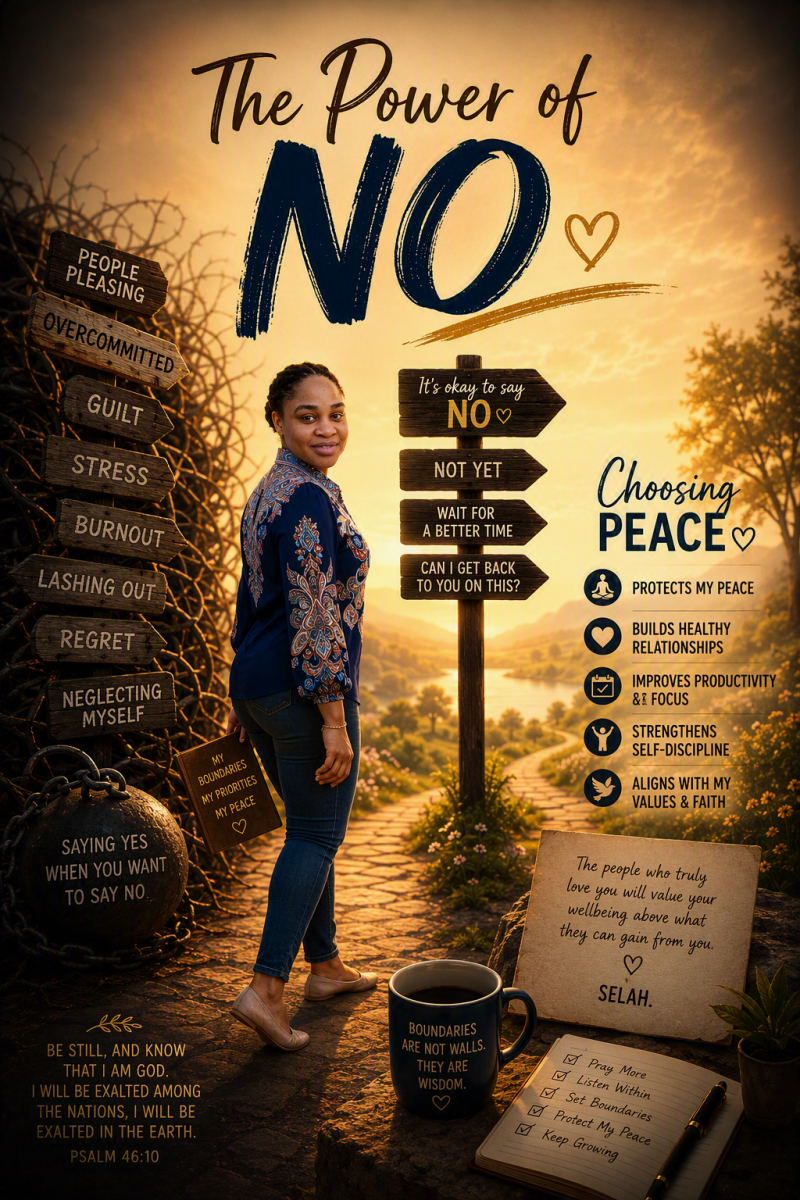
The power of no
For so long, we are conditioned to believe that generosity, devotion, and love are measured by our willingness to say yes. Yet true personal growth and lasting peace begin the moment we understand that love does not always mean acquiescence.
06/09/2026 | Wednesday
Today, I read a story on Facebook that left me thinking long and hard.
A young lady was ripped off by a stranger because she refused to listen to her instincts. She ignored the red flags right in front of her and overrode all the protective nudges from her subconscious.
Why would she do all of this, you might wonder?
Her answer was simple: she did not want to appear wicked.
As a result, she lost money, trust in human goodness, and perhaps even the willingness to help the next stranger who genuinely needs assistance. All because she refused to exercise her right to say No.
The story stayed with me because, until recently, she was a version of me.
Maybe nobody had told her that it is okay to say no occasionally, especially when saying yes will only end in hurt. Maybe no one taught her that her validation, whether for good or bad, should come primarily from within and not from external approval. That is why we have a conscience, and for the Christian, we have the additional help of the Holy Spirit.
The ability to decline requests, commitments, or even relationships in a world that expects constant availability is essential for maintaining balance, autonomy, and that deep sense of peace that fuels true productivity. Not the busyness the world often mistakes for value, but genuine productivity.
A Little Backstory
Growing up, I discovered that I had a remarkable ability to receive a negative response to something I really wanted without allowing it to damage my relationship with the person who declined my request.
Considering that I grew up with five siblings, "No" was a word I heard quite often. It was something we all had to learn to live with because we existed in a world of limited resources. And this had little to do with finances. Sometimes the most limited resources were intangible things, like the twenty-four hours my parents had to divide as fairly as possible among six children.
As an adult, I developed the ability to say no to myself. This became the backbone of my self-discipline. I learned to prioritize difficult tasks over immediate pleasure and to stay focused when distractions beckoned.
However, there were two things I did not learn particularly well:
- Rewarding Myself After the Hard Work Was Done
For the longest time, this felt almost taboo.
No matter what goals I achieved, I could never quite bring myself to unwind. I would simply move on to the next conquest without pausing to celebrate, rest, or reflect.
But that is not the focus of today's treatise.
- Saying No to the People I Love
This sounds noble enough, doesn't it?
Allow me to tell you about the vicious cycle it created.
A loved one would make a request that was clearly beyond my capacity at that moment, perhaps because of time constraints or competing priorities.
Instead of being honest and explaining how the request would disrupt my plans and impact my performance in other areas, I would agree immediately. Then I would return home, lie in bed, and agonize over how I was going to cram everything into an already overloaded schedule.
What did this do to me?
Pressure built unnecessarily because I allowed someone else to set my priorities.
For a long time, my response was simply to push harder. I would trudge on until one day I inevitably lashed out in a manner that seemed completely disproportionate to whatever was happening at the time.
Now I had a wounded loved one who could not understand why I was reacting so strongly.
And me?
I retreated into my shell, deeply remorseful and ashamed of my actions.
The painful part was that I could clearly see the chain of events that led to the explosion, but the people around me could not connect the dots. I would promise myself, my loved one, and the universe that I would do better.
Then another impossible request would come along, and I would walk right back into the same trap.
Talk about a vicious cycle.
Learning the Power of No
I am not exactly sure when the breakthrough came.
But one of the greatest gifts God gave me in 2024 and 2025 was the ability to say:
No.
Not yet.
Wait for a better time.
Or even:
Can I get back to you on this?
I realized that my inability to say no was not evidence of how good a person I was. Rather, it revealed my inability to set healthy boundaries and my limited understanding of my own internal ecosystem.
I began learning to listen when my body quietly asked for rest instead of waiting for a breakdown that sent everything downhill.
I learned to be clear and precise about my limitations instead of avoiding difficult conversations or hiding behind vague responses.
I learned to establish my priorities first and then determine what could fit into them, rather than allowing requests, opinions, and obligations to waltz into my day and dictate my schedule.
Boy, did I learn and grow.
Did this growth come without guilt?
Not at all.
But the most remarkable discovery was that the very people I had spent years bending over backward for were often incredibly understanding. When I gently asked for more time, requested some space, or declined a commitment, they responded with grace and love.
I found myself wondering why I had spent so many years exhausting myself in a futile attempt to prove my love.
I learned that I had the right to decide.
More importantly, I learned that most people did not even require lengthy explanations.
In Summary
1. It Is Okay to Say No
When something is not within your power to do, it is okay to decline.
The people who truly love you will value your wellbeing above what they can gain from you.
2. Give Others the Gift of Choice
As early as possible, I give the people under my care, especially my children, opportunities to choose. When necessary, I clearly explain the consequences associated with those choices.
3. Learn to Receive "No" Gracefully
I have learned to receive the gifts of No, Wait, and Not Yet with much greater equanimity, especially from the people I love most, even when I disagree with their choices.
These days, I am learning to pray more and speak less because I believe in a God who is the Master Communicator, One who speaks the language of every heart and is far better equipped than I am to guide people toward the best decisions.
4. Boundaries Improve Professional Life Too
Learning to pause before committing has helped me professionally.
I am better able to prioritize tasks, avoid crisscrossing meetings, and manage my schedule effectively because I now check my calendar before agreeing to additional commitments.
The result has been greater productivity, improved enjoyment of my work, and significantly less burnout.
5. Peace Lives on the Other Side of Boundaries
I no longer jump at every notification on my phone.
I no longer feel the intense need to measure myself against what others are doing.
My steps are more measured.
My time is more intentional.
I can invest myself fully in the task before me without worrying about what I might be missing elsewhere.
Most importantly, my decisions are now better aligned with my deepest convictions and my faith.
The ability to say No is not selfishness.
It is wisdom.
It is stewardship.
It is self-awareness.
And it is an essential part of daily living, lest we wear ourselves thin trying to be everything to everyone.
Selah.
Create Your Own Website With Webador